
Written by Tim Chamen
When asked to prepare this short article on subsoiling, it gave me the opportunity to delve back into my files some 50 years, to the hot dry years of the mid 1970’s when my colleague Gordon Spoor and I were investigating techniques to improve subsoiling operations (typically 0.40m plus deep) to overcome soil compaction. Soil compaction can negatively affect crop production, soil quality and biological activity, and considerable time and energy are often expended in attempts to alleviate it. Problems arise through increased mechanical impedance restricting root development, impeded air and water movement.
Fig. 1 illustrates how alleviating the compaction layer or pan in a sandy loam soil transformed the root development of sugar beet. In this case increasing the rooting depth by a factor of 3 which maintained the turgidity of the crop and had a significant improvement on moisture availability.


Figure 1. Comparison of sugar beet root development with a soil pan (left) and where the soil pan had been disturbed (right). Godwin and Spoor (2015).
From this work and that of others, the key “take home messages” were:
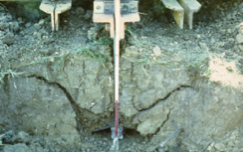
- For good overall soil loosening subsoiler tines with wing attachments (see Fig. 2) significantly increase the volume of soil disturbed for a relatively small increase in draught force.
- This advantage in soil loosening efficiency can be further improved by operating with shallow leading tines (see Fig. 3) which virtually doubles the volume of soil disturbed for no increase in draught force.
- The degree of soil disturbance and clod size at the surface is affected by the lift height of the wings and the tip width of the subsoiler leg.
- Loosened soils are vulnerable to re-compaction, where the subsequent passage of tractor wheels compacted the soil to a greater density than that prior to loosening.
- To avoid this the following suggestions were made:
- Adopt a 1 pass system incorporating deep loosening, surface cultivation and drilling.
- Use lightly loaded tractors fitted with low ground pressure tyre systems.
- Use controlled wheeling’s in a bed or a controlled traffic system.

Figure 2. Soil failure created by a winged tine. After: Spoor and Godwin, 1978.


Figure 3. Soil disturbance from a winged (upper) and winged + shallow leading tine (lower) subsoilers. N.B. Compare the metre rule for scale. After: Spoor and Godwin, 1978.
The above messages albeit originating 50 years ago are fundamental and still apply today. For further details refer to Godwin and Spoor (2015).
Spoor, G and Godwin, R J. (1978) Experimental investigation into the deep loosening of soil by rigid tines. Journal of Agricultural Engineering Research, 23(3), 243‑258.
Soane, G C, Godwin, R J and Spoor, G. (1986) Influence of deep loosening techniques and subsequent wheel traffic on soil structure. Soil and Tillage Research, 8, 231‑237.
Godwin, R J and Spoor, G. (2015) Choosing and evaluating soil improvements by subsoiling and compaction control. In Visual Soil Evaluation: Realizing Potential Crop Production with Minimum Environmental Impact, 66. CABI. https://doi.org/10.1079/9781780644707.0066
No responses yet